Why Experts Say the “Rules-Based International Order” Is Breaking Down
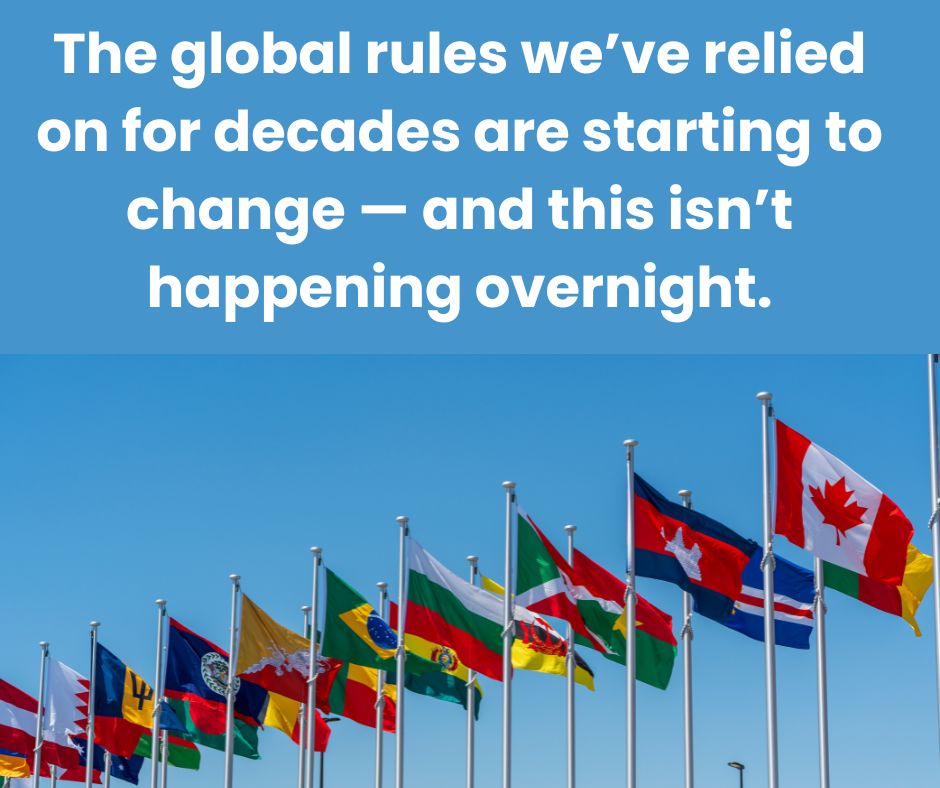
- What the Rules-Based International Order Was
After World War II, Western powers — especially the United States — built a system of international institutions and norms designed to manage global cooperation. This included frameworks for trade (General Agreement on Tariffs and Trade, later the WTO), collective security (NATO, United Nations), financial stability (Bretton Woods institutions), and international law. For decades, this framework helped reduce barriers to trade, create dispute resolution mechanisms, and generally provided predictability in global affairs.
- Cracks Were Always There
Even during its heyday, this system was never perfect:
- Powerful states sometimes ignored or bent rules for their own interests.
- Trade commitments were enforced asymmetrically, depending on who was involved.
- International law was applied with varying rigor.
These shortcomings — often downplayed in rhetoric — were acknowledged by Carney himself, who said the order was “partially false” even when it appeared to function.
- A Rupture, Not a Transition
At the World Economic Forum in Davos, Canadian Prime Minister Mark Carney delivered a stark assessment that global affairs have passed a breaking point. He said the era of a stable rules-based international order — largely enabled by American leadership — is now over, and we are instead in a “rupture” marked by great-power rivalry and unconstrained geopolitics.
Carney warned that:
- The traditional world order is no longer working as designed.
- Powerful states increasingly use economic tools as leverage — including tariffs, financial networks and supply chains as sources of coercion.
- Nations can no longer assume that multilateral institutions will protect them.
His message was echoed by other leaders — including French President Emmanuel Macron — who warned of “a shift towards a world without rules” and a resurgence of power politics.
What Carney’s Message Means for Trade and Global Cooperation
- Strategic Autonomy Over Multilateralism
If the old system of global norms is fading, countries may pursue strategic autonomy — shaping their own economic and security policies without relying on institutions perceived as weak or biased. Carney emphasized that when rules no longer protect you, “you must protect yourself.” This suggests:
- Nations may diversify supply chains.
- Countries will seek bilateral or flexible regional partnerships.
- States may re-evaluate participation in trade deals if enforcement mechanisms are seen as unreliable.
- Trade Becomes a Tool of Leverage
Carney and others point to actions — such as tariff threats tied to geopolitical disputes — as evidence that trade policy is increasingly weaponised. These kinds of measures undermine trust in global trade norms, encouraging countries to erect protections rather than reduce them. If trade becomes less predictable:
- Companies may re-shore operations or build redundancy.
- Countries may impose higher tariffs or other barriers in response to coercion.
- Global value chains could fragment over time, leading to slower growth.
- Middle Powers Must Find New Ways to Cooperate
Carney sees a role for what he calls “middle powers” — countries that are not superpowers but still significant — to form innovative coalitions. Instead of one uniform rules-based system, the future could involve variable geometry: issue-by-issue alliances with common standards where possible. Examples could include:
- Regional trade agreements with flexible governance.
- Coalitions around climate, tech standards, or digital trade.
- Shared security frameworks outside of traditional institutions.
Is the Rules-Based Order Really “Over”? Experts Weigh In
While Carney’s language is striking, many analysts say the institutions themselves have not vanished — rather, their authority and influence are weakening. Some key points from broader reporting:
- Multilateral institutions still exist (UN, WTO, etc.), but enforcement and consensus on major issues are harder to achieve.
- Global trade and diplomacy continue, but unilateral actions and bilateral power plays are more common.
- A world divided into competing blocs — where rules depend on the group involved — is a more likely near-term outcome than total absence of international norms.
So rather than a clean end, many experts describe a transformation or erosion of the old order, not its total disappearance.
What Comes Next?
1. New Forms of Cooperation
Expect to see:
- Flexible trade blocs that reflect shared interests rather than universal rules.
- Sectoral rule-making (e.g., tech standards, data flows, carbon markets) where consensus exists.
- Partnerships driven by shared risks (e.g., supply chain resilience).
2. More Geopolitical Competition
Great-power rivalry — especially between the U.S., China, and Russia — will likely continue to shape global economics.
3. Middle Powers Driving Innovation
Smaller or mid-size states may champion alternative governance models — focusing on transparency, sustainability, human rights norms and cooperative frameworks that are less hierarchical.
- Domestic Pressures Shape Foreign Policy
Trade policy and international commitments will increasingly reflect internal political dynamics — job protection, national sovereignty, and economic resilience — as leaders respond to voter demands.
Conclusion: A More Complex Global Order
Prime Minister Mark Carney’s Davos speech highlighted a widely shared view among policymakers: the familiar rules-based international order is no longer a reliable framework for global governance, and the world is moving toward a less predictable system shaped by power competition, economic coercion, and strategic autonomy. Whether this marks the end of international cooperation or a reconfiguration of global governance depends on the responses of states, businesses, and international institutions in the coming decade.